Vagus nerve stimulation devices for sleep

Vagus nerve stimulation devices for sleep are non-invasive tools for winding down before bed. Explore ZenoWell auricular vagus nerve stimulation devices designed to support calm, better sleep routines, relaxation, and everyday recovery through simple ear-based stimulation.

Sparks Sparks
Sparks
Regular price $10.00
ZenoWell Electrode Earpiece (left ear / right ear) ZenoWell Electrode Earpiece (left ear / right ear)
ZenoWell Gel Pack ZenoWell Gel Pack
-23%
ZenoWell Gel Pack - Conductive Gel for Vagus Nerve Stimulation
Sale price $99.00
Regular price $129.00
ZenoWell Luna Plus — Smart vagus nerve stimulation device for sleep and stress ZenoWell Luna Plus — Smart vagus nerve stimulation device for sleep and stress
-29%
ZenoWell Luna(Gray) non-invasive vagus nerve stimulation device with handheld controller and earpiece,designed for improving sleep quality and relaxation Infographic showing ZenoWell Luna vagus nerve stimulation device and reported changes in sleep quality, stress, HRV, headache intensity, fatigue, and body pain
-32%
ZenoWell Luna: Advanced Vagus Nerve Stimulation for Sleep, Stress & Relief
Sale price $409.00
Regular price $599.00
ZenoWell support pack including the gift set featuring the VITA and LUNA tavns device, three gel, a hoodie, Eye Mask, Wellness Journal, Relaxation Cards, and a gift box, all designed to support relaxation, stress relief, and well-being through transcutaneous auricular vagus nerve stimulation (taVNS) A hoodie, Eye Mask, Wellness Journal, Relaxation Cards, all designed to support relaxation, stress relief, and well-being through transcutaneous auricular vagus nerve stimulation (taVNS).
-13%
ZenoWell TaVNS Support Gift Set
Sale price $379.00
Regular price $437.00
ZenoWell Vita – Activates Vagus Nerve and Paves the Way to Calm ZenoWell Vita – Activates Vagus Nerve and Paves the Way to Calm
-50%
ZenoWell Vita: Simple Vagus Nerve Stimulator for Sleep & Calm
Sale price $239.00
Regular price $479.00
Two sides of a warranty card, featuring ZenoWell branding, instructions for using the device, and registration benefits. A ZenoWell warranty card inspired by the Matterhorn, Switzerland, guiding users on using earpiece for sleep mode.
-100%
Out of Stock
ZenoWell Warranty Card-Extend Your Device Warranty
Sale price $0.00
Regular price $10.00

What to look for in a vagus nerve stimulation device

Vagus nerve stimulation uses controlled electrical pulses to influence pathways associated with the vagus nerve. The term covers several technologies, and the stimulation site changes what is actually being stimulated.

Implanted VNS

  1. An electrode is surgically placed around the cervical vagus nerve
  2. Medical treatment for specific conditions

Cervical nVNS

  1. Through the skin at the neck
  2. Clinical and consumer use varies by device

Auricular taVNS

  1. Selected regions of the outer ear
  2. Research and non-invasive wellness use

Implanted VNS requires surgery and clinical management. Non-invasive systems deliver stimulation through the skin instead.

Auricular taVNS targets sensory pathways associated with the auricular branch of the vagus nerve. Research commonly uses parts of the concha and inner tragus, although no single auricular site has been established as universally optimal.

For sleep-focused consumer products, the role is narrower than medical VNS. These devices are generally used before bed as part of the transition from daytime alertness into a quieter pre-sleep state.

How do vagus nerve stimulation devices work for sleep?

Stimulation through the ear

Ear-based taVNS delivers mild electrical stimulation to selected areas of the outer ear associated with the auricular branch of the vagus nerve. These sensory signals travel toward brainstem and autonomic networks involved in regulating arousal and recovery.

Influence on autonomic and arousal regulation

Because the vagus nerve participates in systems that help the body shift away from sustained alertness, researchers are studying whether taVNS can influence pre-sleep arousal, including the physical and mental activation that can make it difficult to settle at night.

Supporting the transition into sleep

For sleep-focused use, taVNS is better understood as supporting the transition from alertness toward rest rather than directly inducing sleep. Its effect depends on factors such as stimulation site, intensity, session length, and protocol.

Compare vagus nerve stimulation devices for sleep

The main buying differences are where stimulation is delivered, how long the routine takes, and how much setup or software sits around the stimulation.

Comparison
Luna Plus Luna Plus
Vita Vita
Nurosym Nurosym
Pulsetto FIT Pulsetto FIT
Truvaga Plus Truvaga Plus
Comparison Luna Plus Vita Nurosym Pulsetto FIT Truvaga Plus
Stimulation site Concha-based (Cymba and Cavum) ear taVNS Concha-based (Cymba and Cavum) ear taVNS Left tragus Neck Neck
Typical routine 20 minutes 20 minutes 30–60 minutes daily 10-minute Sleep program before bed 2-minute sessions
Device format Ear-worn Ear-worn Ear-worn Hands-free neck wearable Handheld neck device
App required? No for core modes; optional Zeno App No No Yes Yes
Extra setup Minimal Minimal Minimal Conductive gel Electrode solution
Connected features Session history, AI guidance, additional modes, compatible HR/HRV/sleep context Standalone use Primarily standalone App-guided programs App-guided sessions
Practical difference More connected guidance around a standalone ear-based routine Simpler ear-based bedtime routine Longer standalone auricular routine Hands-free cervical routine Very short handheld cervical sessions

Nurosym uses a left-tragus earpiece and a substantially longer daily routine. Pulsetto FIT moves stimulation to the neck and combines a shorter Sleep program with an app and conductive gel. Truvaga Plus is also cervical, but uses very short handheld sessions.

How to use a vagus nerve stimulator before sleep
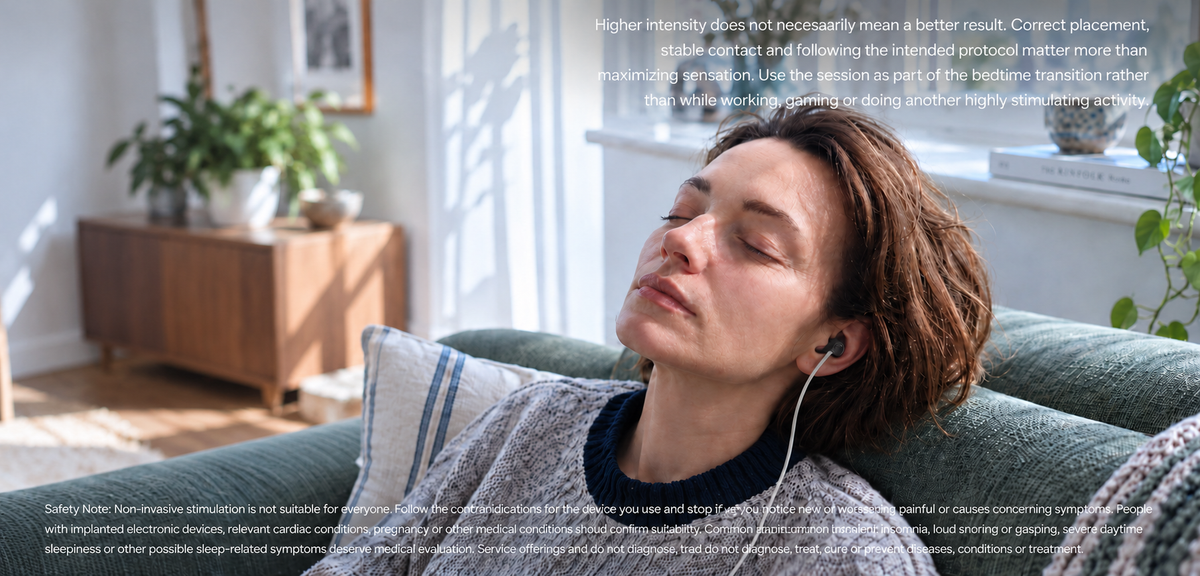
For an ear-based device:

  1. Prepare the earpiece and contact area as instructed.
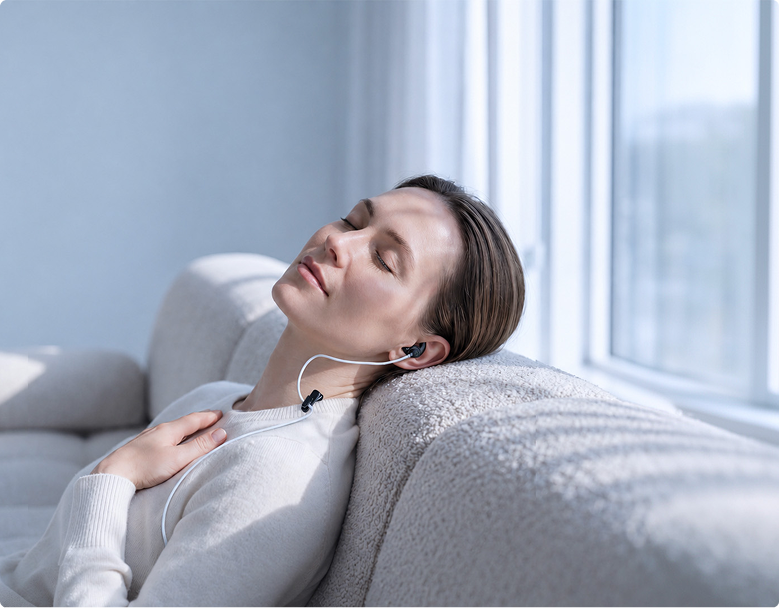
  2. Position it at the device-specific ear target.
  3. Select the sleep-focused mode.
  4. Increase intensity until the sensation is noticeable but comfortable.
  5. Complete the recommended session during a quiet wind-down period.
What does research say about taVNS and sleep?

Current evidence is promising for auricular taVNS in chronic insomnia, particularly for overall sleep quality and insomnia symptoms, but it does not validate every consumer sleep device. Research on taVNS for sleep is still developing, but there is now evidence that goes beyond simply asking whether people feel more relaxed after stimulation. Clinical studies have tested whether taVNS can improve sleep in people with insomnia and whether those improvements are greater than with sham stimulation.

One of the stronger studies came from Shuai Zhang and colleagues in 2024. In a randomized sham-controlled trial, 72 adults with chronic insomnia received either active taVNS or sham stimulation for eight weeks.

Both groups improved, but the active taVNS group improved more. By week eight, Pittsburgh Sleep Quality Index scores had fallen 4.2 points more with active taVNS than with sham, exceeding the study's threshold for a clinically meaningful difference.

That makes the finding more useful than a simple before-and-after improvement. However, the study used 30-minute sessions twice a day, five days a week, so its results should not be assumed to apply to every consumer device or shorter bedtime routine.

FAQ

Do vagus nerve stimulation devices help with sleep?

What type of vagus nerve stimulation is used for sleep?

Where is a vagus nerve stimulator placed for sleep?

When should you use a vagus nerve stimulator for sleep?

Can you use a vagus nerve stimulator every day?